Fabric
Stitched Fabric
Applique
Applied, reverse, single thickness, etc
Foreign items: i.e. shells, mirrors, quills, etc
Quilting
Trapunto -- corded or stuffed
Smocking
Embroidery
Counted Thread
German Brick Stitch
Cross Stitch
Long Arm Cross Stitch
Voided Work
Assisi
Reversi
Counted-thread Blackwork
Pattern Darning
Metal Thread
Surface Couching (metal thread)
Or Nue
Bullion Work
Underside Couching
Canvas Work ("needlepoint")
Tent Stitch
Cross Stitch on Canvas
Brick Stitch
Upright (gobelin) stitch
Satin Stitch
Surface Embroidery
Laid Work
Beadwork
Split Stitch
Crewel
WhiteWork
Drawn Thread
Pulled Thread
Cutwork
Buratto work
Reticella
Painting
Friday, 19 December 2014
TYPES OF SURFACE EMBELLISHMENT

Surface Embellishments
Surface Embellishments
Surface Embellishment: is an important component of freeform, it’s a great way of bringing your personality, our style & our skills to our work & putting our own stamp on our project. There are 1000’s of ways to embellish.1. Surface Slip stitch: start where required, with right side facing & yarn at back, insert hook into sp between 2 sts & draw up a loop, * insert hook in next sp between 2 sts just made as required (above, or to the left or right) & draw up a loop through base-fabric & loop on hook, repeat from * to end, finish off & weave in tail ends on wrong side
2. Surface Slip Stitch can also be worked as follows: start where required, with right side facing & yarn at front, insert hook under a loop of stitch & draw up a loop, 1 ch to secure, * insert hook under next stitch loop (above, or to the left or right) & draw up a loop through stitch loop & loop on hook, repeat from * to end, finish off & weave in tail ends on wrong side. Use this method to bring in yarn for dc (US sc) & ruffles
~~~~~~~~~~~~~~~~~~~~~~~~~~~~~~

Crochet Dots: cut a long length of yarn approx 1metre (40”) or more – start where required, with right side facing & yarn at front, insert hook under a loop of stitch & draw up a loop, *1 ch to secure, * YO, insert hook under same loop & draw up a loop** (repeat from * to ** as many times as desired depending on size dot required), YO & draw through all loops on hook, 1 ch to close, then draw through remaining unused yarn, take this long end to wrong side & bring it back up where the next dot is required **, repeat from * to ** until yarn runs out
~~~~~~~~~~~~~~~~~~~~~~~~~~~~~~
Outlining & defining motifs:


Stem stitch: is a versatile embroidery st that I use a lot… work in contrasting thread or even 2 threads at a time… it’s simple & quick
~~~~~~~~~~~~~~~~~~~~~~~~~~~~~~
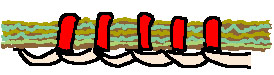
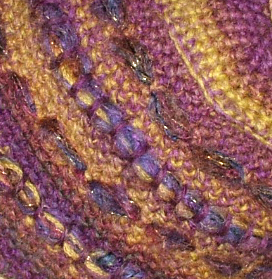
Couching Stitch is another favourite: one yarn lies free on the surface & another yarn is used to tack it down. Use contrasting yarns, ribbons or cords.
~~~~~~~~~~~~~~~~~~~~~~~~~~~~~~
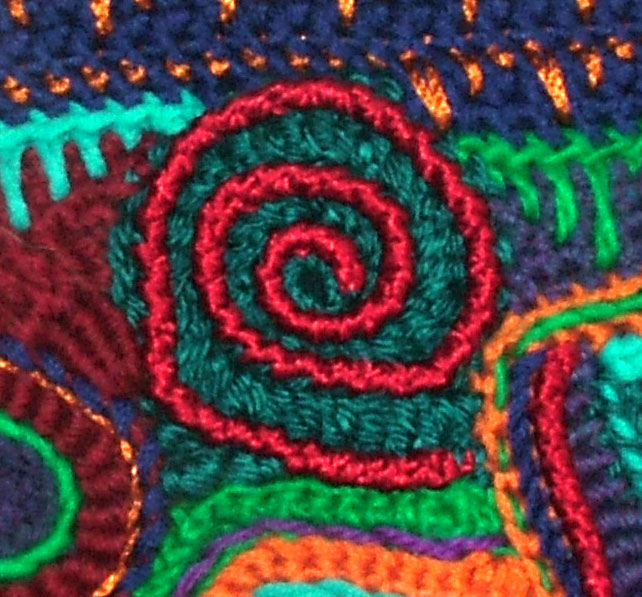
Crab stitch: (reverse dc (US sc)) – Although
Crab stitch is most often used as edging, creating a rope-like finished
edge to your project, it’s also a versitile stitch that can be used in
freefom to tidy an unsightly seam or join or as an embellishment to
liven up a dull, uniteresting patch. Crab stitch can be a little tricky
at first but is soon mastered with a bit of patience & practice.

Embroidery
Embroidery
Embroidery is the handicraft of decorating fabric or other materials with needle and thread or yarn. Embroidery may also incorporate other materials such as metal strips, pearls, beads, quills, and sequins.Embroidery is most often used on caps, hats, coats, blankets, dress shirts, denim, stockings, and golf shirts.
Embroidery is available with a wide variety of thread or yarn color.
An interesting characteristic of embroidery is that the basic techniques or stitches on surviving examples of the earliest embroidery—chain stitch, buttonhole or blanket stitch, running stitch, satin stitch, cross stitch—remain the fundamental techniques of hand embroidery today.
Classification

Japanese free embroidery in silk and metal threads, contemporary.

Embroidery can be classified according to whether the design is stitched on top of or through the foundation fabric, and by the relationship of stitch placement to the fabric.
In free embroidery, designs are applied without regard to the weave of the underlying fabric. Examples include crewel and traditional Chinese and Japanese embroidery.

Counted-thread embroidery patterns are created by making stitches over a predetermined number of threads in the foundation fabric.
Counted-thread embroidery is more easily worked on an even-weave foundation fabric such as embroidery canvas, aida cloth, or specially woven cotton and linen fabrics although non-evenweave linen is used as well.
Examples include needlepoint and some forms of blackwork embroidery.

In canvas work threads are stitched through a fabric mesh to create a dense pattern that completely covers the foundation fabric.
Traditional canvas work such as bargello is a counted-thread technique.
Since the 19th century, printed and hand painted canvases, on which the printed or painted image serves as a guide to the placement of the various thread or yarn colors, have eliminated the need for counting threads.
These are particularly suited to pictorial rather than geometric designs such as those deriving from the Berlin wool work craze of the early 19th century.
In drawn thread work and cutwork, the foundation fabric is deformed or cut away to create holes that are then embellished with embroidery, often with thread in the same color as the foundation fabric. These techniques are the forerunners of needlelace.
When created with white thread on white linen or cotton, this work is collectively referred to as whitework.
The Color
The Color Wheel
A color circle, based on red, yellow and blue, is traditional in the field of art. Sir Isaac Newton developed the first circular diagram of colors in 1666. Since then, scientists and artists have studied and designed numerous variations of this concept. Differences of opinion about the validity of one format over another continue to provoke debate. In reality, any color circle or color wheel which presents a logically arranged sequence of pure hues has merit.Primary Colors: Red, yellow and blue
In traditional color theory (used in paint and pigments), primary colors are the 3 pigment colors that can not be mixed or formed by any combination of other colors. All other colors are derived from these 3 hues.
Secondary Colors: Green, orange and purple
These are the colors formed by mixing the primary colors.
Tertiary Colors: Yellow-orange, red-orange, red-purple, blue-purple, blue-green & yellow-green
These are the colors formed by mixing a primary and a secondary color. That's why the hue is a two word name, such as blue-green, red-violet, and yellow-orange.
Color Harmony
Harmony can be defined as a pleasing arrangement of parts, whether it be music, poetry, color, or even an ice cream sundae.
In visual experiences, harmony is something that is pleasing to the eye. It engages the viewer and it creates an inner sense of order, a balance in the visual experience. When something is not harmonious, it's either boring or chaotic. At one extreme is a visual experience that is so bland that the viewer is not engaged.Color harmony delivers visual interest and a sense of order.

 Harmony is a dynamic equilibrium.
In visual experiences, harmony is something that is pleasing to the eye. It engages the viewer and it creates an inner sense of order, a balance in the visual experience. When something is not harmonious, it's either boring or chaotic. At one extreme is a visual experience that is so bland that the viewer is not engaged.Color harmony delivers visual interest and a sense of order.
DRAPERIES
DRAPERIES
Introduction:
Drapery is
a general word referring to cloths or textiles (Old French draperie,
from Latin word drappus). It may refer to cloth used
for decorative purposes. such as around windows or to the trade of retailing
cloth, originally mostly for clothing, formerly conducted by drapers.
There are many
different styles and shapes of drapery
Meaning of drapery:
Drapes are
similar to draperys sold in panels of fabric with many different lengths,
colors, and patterns but are normally made of heavier fabric, lined, pleated
and hung on a traverse rod with a string so we can easily open and close them.
Drapes are more grand and found in formal-type rooms, such as a dining room,
parlor, or master bedroom.
Method of
finishing Drapery:
The very top of a drapery is
called the heading. It is formed
by pleating, pinching, gathering, grommeting or tying. A stiffner or buckram
is inserted or wrapped into the heading when it needs to be stiff.
The type of drapery needed for the window covering will dictate what type of
heading and buckram if any should be used. Pleated type headings work best for
drawing or traversing drapery across an opening and can be used on conventional
type traverse rods, pole and ring, or motorized rods. The other types listed
are better suited for stationary or non-functioning type drapery.
At Window Wears, we can custom make
any combination of drapes and drapery. Below are the most common types that we
fabricate.
Functional Drapes:
In terms of function, drapes and
window treatments are typically used to control light, block out the cold
and/or heat, provide privacy, and help mute sounds and prevent echoing).
The
most common types of function drapes are:
·
Pinch pleat drapery
(also known as draw drapery) – these types of drapes open as a pair or
draw to one side or the other.
Non-Functional Drapes:
In terms of form, drapes and window
treatments can be used to add personality to a room, to frame a window, to
focus our eye on the window, to make rooms seem taller or shorter, to provide
accents, to add warmth and color, to dress a room up or down, and to compensate
for windows that aren’t the same height. The most common types of form drapes
are:

DRAPERIES
WEAVING SOFTWARE
Weave Maker
is powerful, professional design software that makes sense to designers. It is
the perfect software tool for the intermediate to advanced designer of woven
fabrics. WeaveMaker is packed with features for dobby design. Realistic fabric
rendering, direct design creation (draw your design as you want it woven), and
full-fabric float analysis and correction is super easy and fast.
Create
original designs quickly, or enter an existing design in any of several ways
(visual and numeric input capabilities).
Built-in
yarn calculator (metric, cotton, worsted, linen, denier, tex, yards per pound
and grams per meter). Many technical features, including denting, beaming, and
stop motion.
Whether
working for a mill or as a free-lancer, designing by hand or with CAD software,
using WeaveMaker will help you to:
- Automatic
pattern generation
You set the guidelines and WeaveMaker will automatically generate patterns. After spending thousands of hours interviewing and working with designers and weavers, our software developers created these automatic pattern generators that allow WeaveMaker to produce weaves that fit many styles. Every weave created by the automatic pattern generators is unique! - Repeats
WeaveMaker gives you simple, friendly tools to make straight repeats, mirrored repeats and other variations, in weaving elements (threading, treadling, peg plan) and in warp and weft color assignment. - 3D
Fabric viewer
WeaveMaker will show you a piece of your fabric in 3D, so you can examine your weave in detail!
- Ability
to rearrange harnesses even after design is completed
Improve the efficiency of your loom threading by rearranging harnesses, after you have completed your design. WeaveMaker makes all the necessary adjustments. - Warp
threading and color locking capabilities
Develop dozens of patterns from a single warp.
- Increase your personal productivity. Produce more designs in less time with fewer errors and more confidence.
- Spend more time on design and less on tedious thread-by-thread editing.
- Create fresh, new looks.
- Use longer repeats.
- Use color more effectively.
- Tackle complex weave structures and color arrangements.
Weaveit
·
WeaveIt is a weaving software program for creating,
designing and displaying Weaving drafts and patterns. Weavers create the
threading, treadling and tie-up and WeaveIt will display the draft as a
drawdown. Handweavers will appreciate the ability to calculate yarn yardage and
the number of heddles.
·
WeaveIt
supports Windows XP and Windows Vista, and Windows 7. It will
also support the older systems of Windows 98/ME/NT4/2000.
·
There
are two versions of the program, a Basic version for someone who likes
to create draw downs and a Pro version for the person who wants more
design capability. The Pro version has all the capability of the Basic version
so that hand weavers can use as much as they are ready for.
Advanced hand weavers will love the many design
tools available: Block substitution, Double Weave, Fabric Analysis, Taquete and
Polychome Design, turning and blending drafts, plus the many means of free-form
designing and editing of drafts.Wednesday, 17 December 2014
INTELLIGENT TEXTILES
INTELLIGENT
TEXTILES
INTRODUCTION
Materials are
considered to be textile when they consist of drape able structures that can be
processed on textile machinery. Usually textiles are made of fine and flexible
fibres and threads that have a high length/diameter ratio. The hierarchical
structure are made of bundles of fibres are twisted to create yarns, which again
are e.g. woven or knitted into fabrics. However, textiles can also contain
non-woven structures as membranes and foils. Ready-made textile products
include ropes, ribbons, fabrics and also three-dimensional products like
clothing.
MEANING
What does it mean when
we say that skin is truly intelligent? It does not have a brain. Intelligence
is described in the Encyclopaedia Britannica as “the ability to adapt
effectively to the environment, either by making a change in oneself or by
changing the environment or finding a new one. Effective adaptation draws upon
a number of cognitive processes, such as perception, learning, memory,
reasoning, and problem solving. This definition is from the psychologist’s
viewpoint, but still holds up for human skin.
DEFINITION
There are no definite
law about what is considered intelligent. In addition, things have varying
degrees of intelligence. People tend to use the terms way too much, especially
for marketing purposes. Here are four quite similar explanations of intelligent
textiles:
They are materials that react to
impulses without the need for us to control them.
They are able to respond to its
environment.
In garment they react to impulses coming
from outside or inside.
They react automatically to some kind of
stimuli.


INTELLIGENT TEXTILES
Subscribe to:
Posts (Atom)